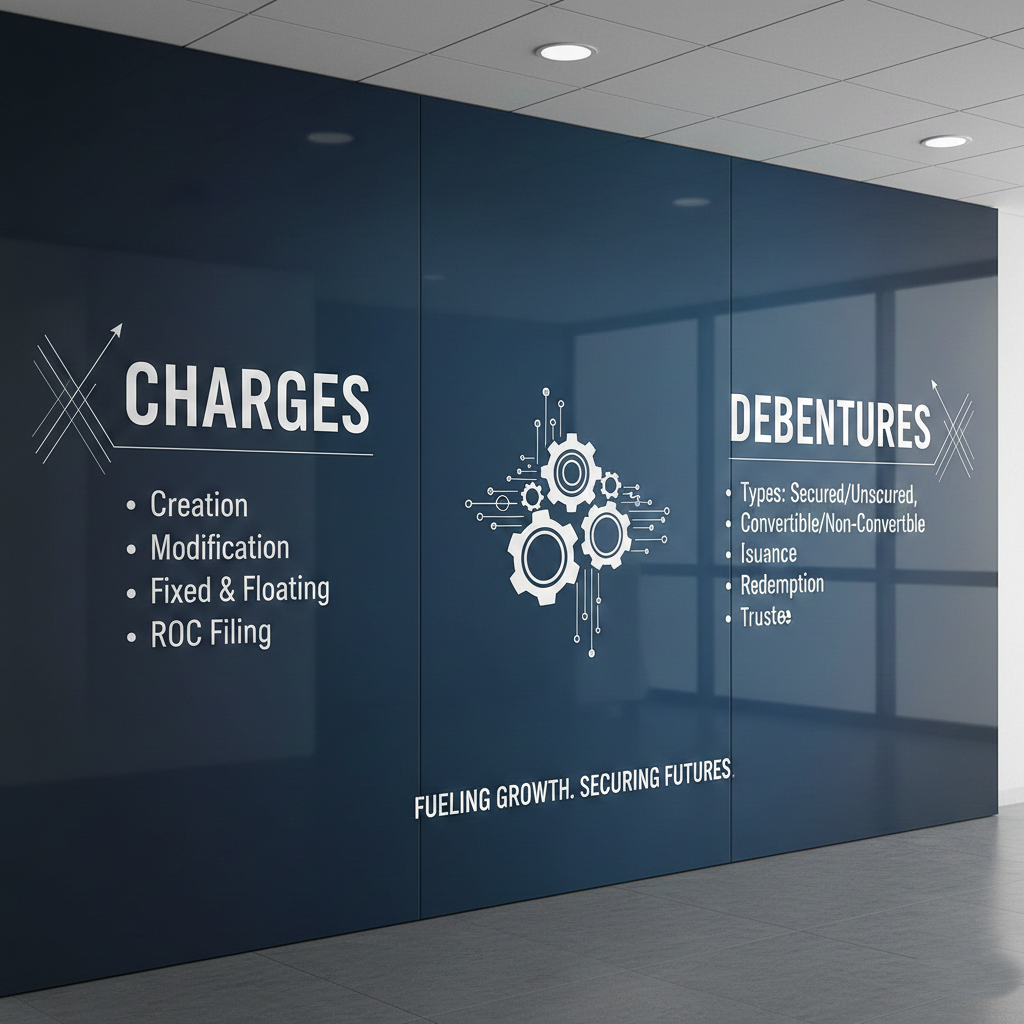
6. Charges and Debentures
In company law as, charges and debentures are fundamental mechanisms for corporate borrowing, governed primarily by the Companies Act, 2013, and SEBI regulations for listed entities.
1. Basic Idea: Charges
A charge is a security interest or lien created on a company's assets or property to secure the repayment of a debt (such as a loan or debentures).
- Fixed Charge: Created on specific, identifiable assets (e.g., land, heavy machinery). The company cannot sell these assets without the lender's consent.
- Floating Charge: Created on a class of circulating assets (e.g., stock-in-trade, debtors) that change in the ordinary course of business.
- Crystallization: The process where a floating charge becomes a fixed charge, typically upon default or liquidation.
2. Basic Idea: Debentures
A debenture is a debt instrument issued by a company as evidence of its indebtedness toward the holder, typically carrying a fixed interest rate.
- Nature: Debenture holders are creditors, not owners; they do not have voting rights.
- Secured vs. Unsecured: Secured debentures are backed by a charge on company assets, while unsecured (naked) debentures rely solely on the company's creditworthiness.
- Convertibility: Some debentures can be converted into equity shares at a later date.
Key Compliance Requirements
Compliance is strictly monitored by the Registrar of Companies (ROC) and SEBI.
- Registration of Charges:
- Form CHG-1/CHG-9: Companies must file particulars of a charge with the ROC within 30 days of its creation. Use Form CHG-9 specifically for debentures.
- Certificate of Charge: The ROC issues a certificate (CHG-2) once registered, which acts as conclusive evidence.
- Modification & Satisfaction: Any change in terms (Form CHG-1/9) or full repayment (Form CHG-4) must also be registered.
- Debenture-Specific Compliance:
- Debenture Trustee: For public issues exceeding 500 people, the company must appoint a SEBI-registered Debenture Trustee to protect investor interests.
- Debenture Redemption Reserve (DRR): Companies must create a DRR from profits to ensure funds are available for redemption.
- Registers: Companies must maintain a Register of Charges (Form CHG-7) and a Register of Debenture Holders (Section 88) at their registered office.
- Consequences of Non-Compliance:
- Invalidation: An unregistered charge is void against a liquidator or other creditors in the event of winding up.
- Penalties: Companies may face fines ranging from ₹1 lakh to ₹10 lakhs, and defaulting officers may face imprisonment or additional fines